
ChEBI's entity of the month: Oleocanthal
The latest ChEBI 'entity of the month' looks at the remarkable properties of a compound found in extra-virgin olive oil
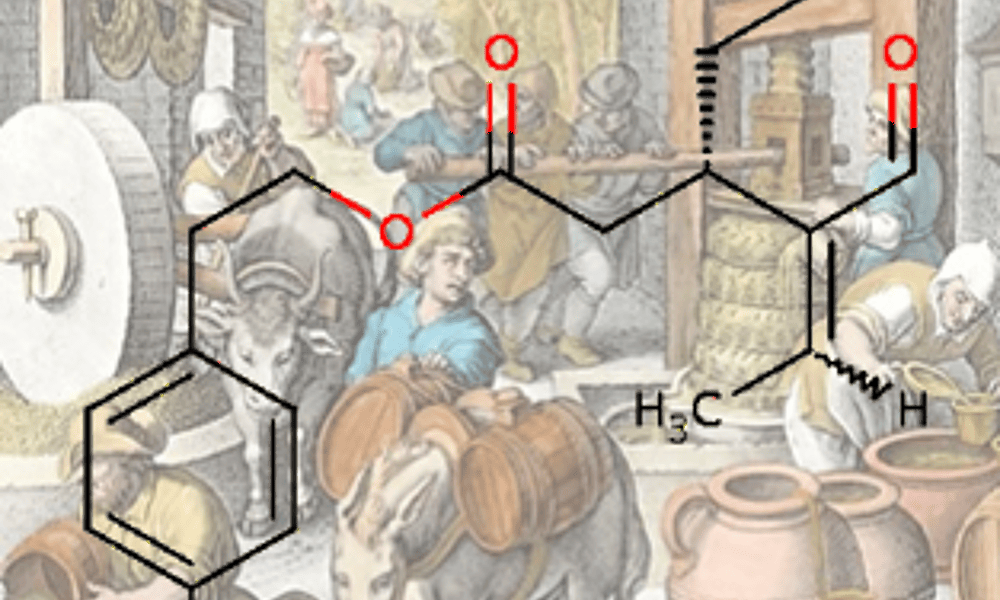
The Mediterranean diet is characterised by a relatively high intake of extra-virgin olive oil (EVOO), fruit, unrefined cereals, and vegetables; moderate amounts of fish, poultry and wine; and relatively low amounts of dairy products, red and processed meats. It has been associated with a number of beneficial health properties, including reduced incidences of cardiovascular disease; age-related cognitive disease; colorectal, prostate, and aerodigestive cancers; and a reduction in overall cancer mortality [1-3].
For many years, the health benefits of the diet were attributed to oleic acid, the major component of EVOO. However, when it was shown that the consumption of other seed oils containing similar concentrations of monounsaturated fatty acids does not result in comparable health benefits [4], attention turned to the polyphenolic components of EVOO.
The discovery of oleocanthal
First isolated by Gianfrancesco Montedoro and co-workers at the University of Perugia over twenty years ago [5], a dialdehydic phenol present in EVOO known as (–)-decarboxymethyl ligstroside aglycone was subsequently shown by Paul Andrewes and co-workers at Unilever R&D in Vlaardingen, The Netherlands, to be responsible for the bitterness, pungency and astringency causing the 'throat burn' sensation of many EVOOs [6]. In 2005, Gary Beauchamp and co-workers determined the absolute stereochemistry of the compound and gave it the more convenient name "oleocanthal" (OC; CHEBI:85673) [7].
It has been known for many years that the bitterness of certain compounds correlates with their pharmacological activity [8]. Since oleocanthal caused a similar 'sting in the throat' sensation to the non-steroidal anti-inflammatory drug ibuprofen, Beauchamp's group correctly predicted that, like ibuprofen, OC should have anti-inflammatory properties. They found that not only did OC behave like ibuprofen in inhibiting the action of both cyclooxygenase-1 (COX-1) and COX-2, it was actually significantly more active. Their findings supported the idea that oleocanthal could be a factor in a number of the health benefits associated with the Mediterranean diet.
Since COX-2 has been implicated in the pathogenesis of various inflammatory diseases [9,10] and several cancers [11,12] and since OC is a naturally occurring COX-2 inhibitor, it is not surprising that OC has become a compound of significant interest in drug research. Potentially beneficial properties of oleocanthal reported in recent years include the modulation of tau protein fibrilisation [14] and the enhancement of amyloid-β clearance from the brain [15] – both may have important implications for the treatment of neurodegenerative diseases.
Most recently, a group led by Prof. David Foster of the Hunter College of the City University of New York has reported on research into the effect of oleocanthal on cultures of human breast, prostate, and pancreatic cancer cell lines. Remarkably, they found that OC rapidly induced cell death in all of the cancer cells studied, whereas with non-cancerous cells, it caused reversible cell cycle arrest – effectively putting the cells to sleep for a while – but did not cause cell death [13].
Shortage of supply
Oleocanthal is vulnerable to decomposition on exposure to oxygen and light, and is present in olive oil in relatively small amounts (typically between 100 and 160 mg per kg of oil, depending on the time of harvest). Its total synthesis is not currently a viable option as it requires about 10 separate steps, and overall yields are quite low [16,17]. As a consequence, the availability of OC for research has been a problem. Most studies on oleocanthal to date have been in vitro; for in vivo studies, much greater amounts would be required. However, the discovery that significant amounts of OC can be obtained from olive pomace waste [18] and the recent publication of a gentle preparative isolation using high-performance countercurrent chromatography (HPCCC) [19] should help matters.
Pictured: The chemical structure of oleocanthal against a depicting the production of olive oil, from an engraving by Philip Galle (1537–1612). The background image is a detail from a Creative Commons licensed image taken from Wikimedia Commons.
Reference(s)
- Sofi, F., Cesari, F., Abbate, R., Gensini, G.F. and Casini, A. (2008) Adherence to Mediterranean diet and health status: meta-analysis. BMJ [Br. Med. J.], 337(7671), a1344.
- Sofi, F., Abbate, R., Gensini, G.F. and Casini, A. (2010) Accruing evidence on benefits of adherence to the Mediterranean diet on health: an updated systematic review and meta-analysis. Am. J. Clin. Nutr., 92(5), 1189–1196.
- Schwingshackl, L. and Hoffmann, G. (2014) Adherence to Mediterranean diet and risk of cancer: a systematic review and meta-analysis of observational studies. Int. J. Cancer, 135(8), 1884–1897.
- López-Miranda, J., Pérez-Jiménez, F., Ros, E., De Caterina, R., Badimón, L., et al. (2010) Olive oil and health: summary of the II international conference on olive oil and health consensus report, Jaén and Córdoba (Spain) 2008. Nutr., Metab. Cardiovasc. Dis., 20(4), 284–294.
- Montedoro, G., Servili, M., Baldioli, M., Selvaggini, R., Miniati, E. and Macchioni, A. (1993) Simple and hydrolyzable compounds in virgin olive oil. 3. Spectroscopic characterizations of the secoiridoid derivatives. J. Agric. Food Chem., 41(11), 2228–2234.
- Andrewes, P., Busch, J.L.H.C., de Joode, T., Groenewegen, A. and Alexandre, H. (2003) Sensory properties of virgin olive oil polyphenols:âidentification of deacetoxy-ligstroside aglycon as a key contributor to pungency. J. Agric. Food Chem., 51(5), 1415–1420.
- Beauchamp, G.K., Keast, R.S., Morel, D., Lin, J., Pika, J., Han, Q., Lee, C.H., Smith, A.B. and Breslin, P.A. (2005) Ibuprofen-like activity in extra-virgin olive oil. Nature, 437(7055), 45–46.
- Fischer, R., Griffin, F., Archer, R.C., Zinsmeister, S.C. and Jastram, P.S. (1965) Weber ratio in gustatory chemoreception; an indicator of systemic (drug) reactivity. Nature, 207(5001), 1049–1053.
- Parkinson, L. and Keast, R. (2014) Oleocanthal, a phenolic derived from virgin olive oil: a review of the beneficial effects on inflammatory disease. Int. J. Mol. Sci., 15(7), 12323–12334.
- Scotece, M., Conde, J., Abella, V., Lopez, V., Pino, J., Lago, F., Smith, A.B.III, Gómez-Reino, J.J., and Gualillo, O. (2015) New drugs from ancient natural foods. Oleocanthal, the natural occurring spicy compound of olive oil: a brief history. Drug Discovery Today, 20(4), 406–410.
- Ristimäki, A., Sivula, A., Lundin, J., Lundin, M., Salminen, T., Haglund, C., Joensuu, H. and Isola, J. (2002) Prognostic significance of elevated cyclooxygenase-2 expression in breast cancer. Cancer Res., 62(3), 632–635.
- Harris, R.E., Chlebowski, R.T., Jackson, R.D., Frid, D.J., Ascenseo, J.L., Anderson, G., Loar, A., Rodabough, R.J., White, E. and McTiernan, A. (2003) Breast cancer and nonsteroidal anti-inflammatory drugs: prospective results from the Women's Health Initiative. Cancer Res., 63(18), 6096–6101.
- LeGendre, O., Breslin, P.A.S. and Foster, D.A. (2015) (–)-Oleocanthal rapidly and selectively induces cancer cell death via lysosomal membrane permeabilization (LMP). Mol. Cell. Oncol., 2(3462), Published online 23 Jan. 2015.
- Monti, M.C., Margarucci, L., Riccio, R. and Casapullo, A. (2012) Modulation of tau protein fibrillization by oleocanthal. J. Nat. Prod., 75(9), 1584–1588.
- Abuznait, A.H., Qosa, H., Busnena, B.A., El Sayed, K.A. and Kaddoumi, A. (2013) Olive-oil-derived oleocanthal enhances β-amyloid clearance as a potential neuroprotective mechanism against Alzheimer's disease: in vitro and in vivo studies. ACS Chem. Neurosci., 4(6), 973–982.
- Smith, A.B.III, Sperry, J.B. and Han, Q. (2007) Syntheses of (–)-oleocanthal, a natural NSAID found in extra virgin olive oil, the (–)-deacetoxy-oleuropein aglycone, and related analogues. J. Org. Chem., 72(18), 6891–6900.
- Valli, M., Peviani, E.G., Porta, A., D'Alfonso, A., Zanoni, G. and Vidari, G. (2013) A concise and efficient total synthesis of oleocanthal. Eur. J. Org. Chem, (20), 4332–4336.
- Cicerale, S., Conlan, X.A., Barnett, N.W. and Keast, R.S. (2011) The concentration of oleocanthal in olive oil waste. Nat. Prod. Res., 25(5), 542–548.
- Adhami, H.R., Zehl, M., Dangl, C., Dorfmeister, D., Stadler, M., Urban, E., Hewitson, P., Ignatova, S. and Krenn, L. (2015) Preparative isolation of oleocanthal, tyrosol, and hydroxytyrosol from olive oil by HPCCC. Food Chem., 170, 154–159.