Darwin Tree of Life at the Royal Society Summer Science Exhibition
A closer look at how genome sequencing is helping us protect biodiversity and our latest public engagement activities
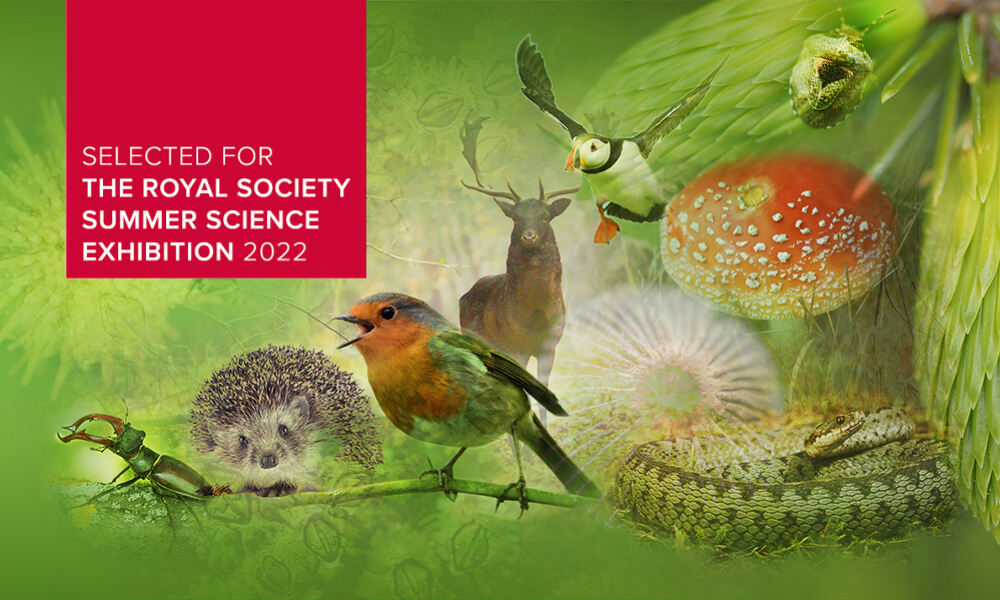
A landmark project to sequence the genomes of all 70,000 species of eukaryotic organisms in Britain and Ireland will be on show this summer at one of the largest free science festivals in the UK.
The Darwin Tree of Life (DToL) project, a collaboration between eight leading research organisations and funded by Wellcome, brings together experts in biodiversity, genomics and DNA analysis. The project will be one of 16 exhibits on show to the public during the 2022 Royal Society Summer Science Exhibition.
From 6 July to 10 July 2022, visitors to the Royal Society in London will have the opportunity to meet world-leading researchers and discover cutting-edge science through a range of interactive experiences, activities and workshops.
Get involved
Researchers from our Ensembl team will be taking part in the exhibition alongside collaborators from the other DToL partner institutes. At the DToL stand, attendees will have the opportunity to take part in a fun but challenging card-based game that will help them understand the huge variety of species that will be sequenced as part of the DToL project.
“Ensembl colleagues and I are thrilled to be taking part in the Royal Society Summer Science Exhibition,” said Alexey Sokolov, Project Lead at EMBL’s European Bioinformatics Institute (EMBL-EBI). “It’s a fantastic opportunity for us to demonstrate the interdisciplinary nature of scientific research and the variety of skills and experience needed in such large scale projects. For example, I’ll be talking about computational aspects of DToL, including multi-cloud deployment that will help guarantee service stability and scalability for the project.”
“Bioinformatics isn’t always the most accessible field for non-scientists,” said Briony Jackson, Public Engagement Officer at EMBL-EBI. “But the activities we’ve prepared for the Exhibition will showcase just how important the combination of biology and computer science are for understanding the world around us and protecting biodiversity.”
Our public engagement activities
The DToL project has also provided us with the opportunity to demonstrate EMBL-EBI research to a public audience and to get people involved. We’ve created Our Animal DNA, an activity that gives high school students aged 16–18 years old the opportunity to use our bioinformatics tools to compare sequence data from the DToL project. Our Animal DNA is available to download and you can take part in the classroom or at home.
In partnership with ACCESS – a charity for supporting migrants living in the East Anglian region – we are also engaging with local migrant communities around the DToL species and the science underpinning nature in their local area. For this, we have set up a public engagement activity in Bawsey Country Park with the hope to expand to other areas. The activity combines geocaching with collectable cards that participants can find and use to learn more about the DToL species.
Discover other EMBL-EBI public engagement events taking place both virtually and in person.
EMBL-EBI and the DToL project
Researchers at EMBL-EBI are supporting the DToL project by storing and annotating the genomes sequenced, and making this data openly available through the DToL Data Portal. Genome annotations produced as part of the project are created by Ensembl and the European Nucleotide Archive (ENA) teams at EMBL-EBI, and play a vital role in making the DToL data freely available to the scientific community.
This work is also a vital part of the Planetary Biology theme in the EMBL Molecules to Ecosystems Programme. This theme, promulgated across EMBL, aims to understand how microbes, plants, and animals respond to each other and to their environment.
Find out more about DToL at EMBL-EBI and check out the full programme of activities at the Royal Society Summer Science Exhibition 2022.
Read more about DToL at the Royal Society Summer Science Exhibition on the Earlham Institute news page.
More about the DToL project
The Darwin Tree of Life project aims to understand how the diversity of life on Earth evolved, explore the biology of organisms and ecosystems, aid conservation efforts, and provide new tools for medicine and biotechnology. It is one of several initiatives across the globe working towards the ultimate goal of sequencing all complex life on Earth, in a venture known as the Earth BioGenome Project.
This project is a collaboration between the Earlham Institute, EMBL-EBI, Marine Biological Association, Natural History Museum, Royal Botanic Garden Edinburgh, Royal Botanic Garden Kew, and the Wellcome Sanger Institute, along with teams at the Universities of Cambridge, Edinburgh and Oxford.