Art meets structural biology
The Protein Data Bank in Europe celebrates its schools art project with its largest exhibition yet
About
- PDBe has worked with local school students to create artworks inspired by proteins
- PDBe offers free access to numerous 3D macromolecular structures, which served as inspiration for the project
- The project culminated with an art exhibition in central Cambridge and a 2019 calendar
25 July, Cambridge – “I’ve spent my whole life looking at protein structures and there’s nothing quite as beautiful. Today, it’s so nice to see others inspired by these structures.” This is how Janet Thornton, Director Emeritus of the European Bioinformatics Institute (EMBL-EBI) and Senior Scientist welcomed visitors to the opening of the exhibition organised by the Protein Data Bank in Europe (PDBe). The exhibition, entitled ‘Artworks inspired by life’s building blocks’, runs from 16-28 July at Michaelhouse Café in Cambridge, UK.
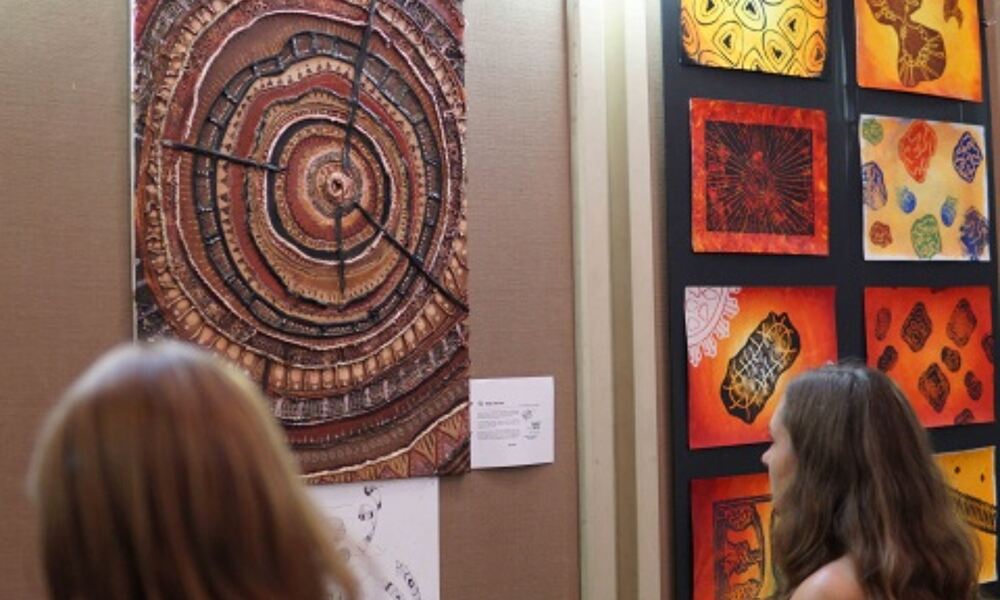
Visitors can explore a range of paintings, sculptures and fashion designs created by local school students and inspired by the 3D protein structures available at PDBe.
 Scientists, art lovers, school students and friends gathered in Michaelhouse Café in Cambridge to celebrate the official opening of the PDBArt exhibition. PHOTO: Oana Stroe/EMBL-EBI
A unique collaboration
The Protein Data Bank is a worldwide archive of protein, DNA and RNA structures. It’s based at three sites around the world, in Japan, the US, and in the UK at EMBL-EBI.
For the last two years, the PDBe team has worked with local schools and art societies to inspire pupils with science. After exploring 3D macromolecular structures and discussing with scientists what the proteins do, the students are encouraged to create their own artistic interpretations. The students explore new ideas using different materials, so there’s a lot of development from the original discussion to the final artwork. This ensures the resulting artworks are very diverse.
See video: Behind the scenes - PDBe's 'Artworks inspired by life's building blocks
“Working with the students, seeing what captures their imagination and observing their artworks develop over the course of the past year has been a truly inspiring experience,” says David Armstrong, Outreach and Training Coordinator at PDBe. “I would encourage more scientists to get involved in this type of project; it’s a good way of stepping out of your comfort zone and it can be extremely satisfying; you can also learn a lot about different ways that science can be interpreted and represented.”
 Twelve artworks will feature in PDBe’s 2019 calendar. PHOTO: Oana Stroe/EMBL-EBI
Exploration and curiosity
“The best part about the course was being able to have art and science together, not isolating each subject, having everything combined,” explains Henry N., who studies at Impington Village College. “I feel quite proud; I’ve never had that before.”
“I wanted to show the impact that science, proteins and Alzheimer’s disease have on people, so I went large-scale because I think it draws people in and it makes you feel consumed by the piece, which is also what the disease does,” says Lucy Tunsley, student at Stephen Perse Foundation Sixth Form College.
 Disruption of the Mind – an artwork by Lucy Tunsley, portraying the effects of tau tangles in Alzheimer’s disease. PHOTO: Oana Stroe/EMBL-EBI
“The artistic impulse springs from within, while science is very much focused on the external world,” says Liz Tyszka, Young Arts Committee Member for the Art Society CANTAB. “This exhibition brings the two together. The unique character of the project also attracts extremely passionate and talented people – it has been a pleasure working with them and we hope to see the project continue to grow in the future.”
PDB Art 2018 was a collaboration with the Leys School and the Perse School in Cambridge, Impington Village College and the Stephen Perse Foundation, with support from the Art Society CANTAB and the Art Society GRANTA.
 The 2018 artworks include paintings, ceramics and fashion designs. PHOTO: Sreenath Nair /EMBL-EBI
Find out more
You can find out more about the project on the PDBe website and read more about the stories behind the calendar artworks in the featured structures section.
Funding
This project was funded by the Wellcome Trust (Grant number: 104948). The video was possible with support from the WGC Public Engagement team.